 By st20113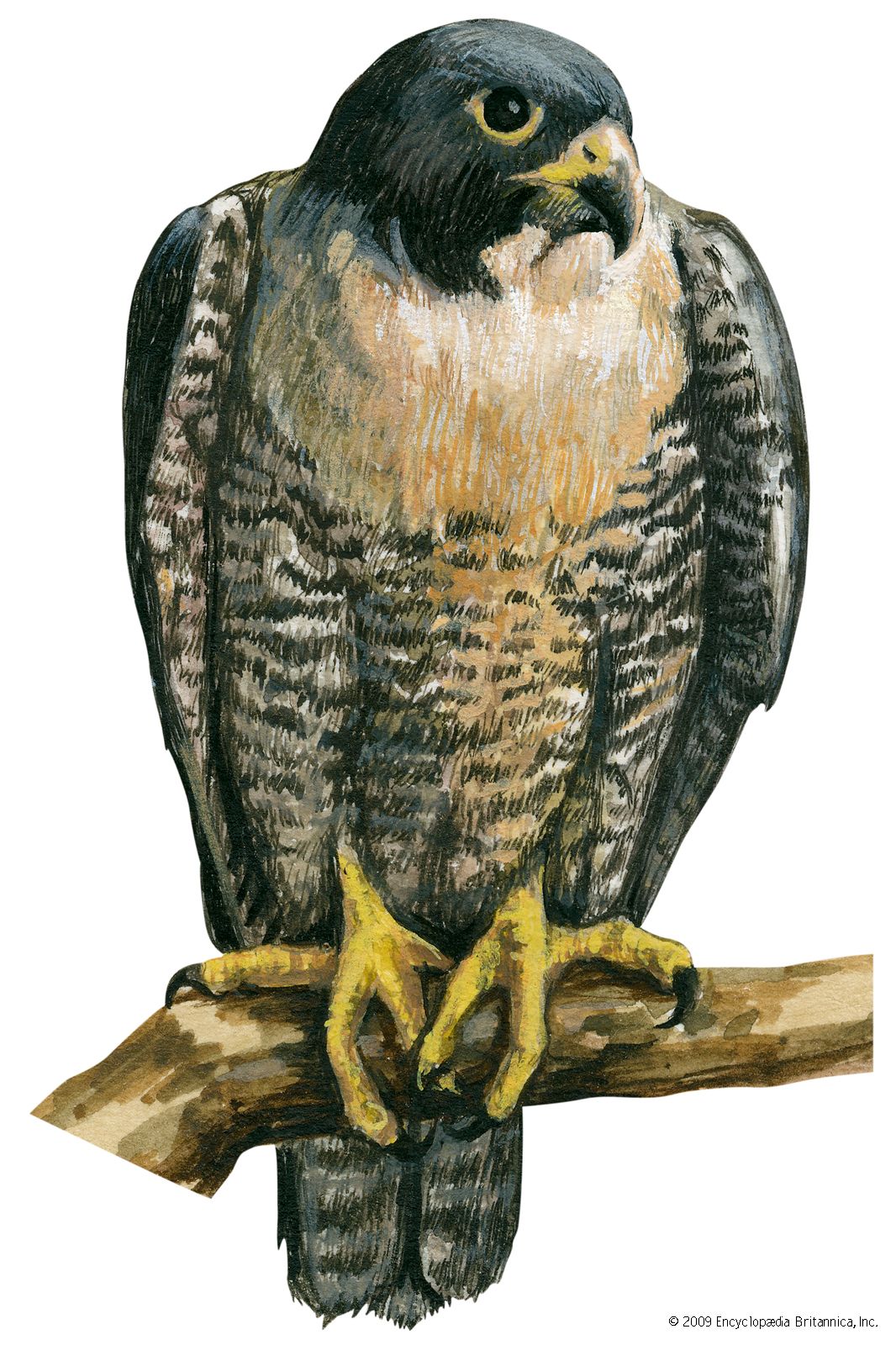
The peregrine falcon is a medium-sized bird of prey renowned as the fastest animal on Earth. During its hunting stoop, a high-speed dive in which it folds its wings and plummets toward prey, the falcon can exceed speeds of 390 kilometers per hour, faster than any cheetah, any aircraft in a dive, and any other living creature. This astonishing velocity makes the species a subject of fascination for biologists who study the mechanics of flight and for engineers who design everything from aircraft to wind turbines.
Adult peregrines are built for speed and power. They typically measure 34 to 58 centimeters long, with a wingspan of roughly 74 to 120 centimeters, and females are notably larger than males, a pattern common among birds of prey. Their plumage is a sleek blue-gray above and pale below, marked with dark barring on the underside and a distinctive black moustache stripe below each eye. The head is rounded and the beak is short and hooked. A key adaptation for high-speed flight is the narial bump, a small bony tubercle inside each nostril that breaks up the rush of air entering the breathing passages during a dive, allowing the bird to breathe and to withstand the crushing pressure of the wind. Transparent third eyelids protect the eyes while the falcon streaks toward its target.
Peregrines are among the most widely distributed birds in the world, found on every continent except Antarctica. They inhabit an extraordinary range of environments, from arctic tundra and open coastlines to deserts, mountains, and temperate forests. In recent decades they have become famous for their adaptation to cities, where they nest on the ledges of skyscrapers and bridges that mimic the cliffs they traditionally use. Urban peregrines prey on pigeons, starlings, and other city birds, and because cities stay warmer than the surrounding countryside, some pairs can raise young earlier in the year. This closeness to people has made the species a familiar sight in great cities and a symbol of wildlife’s ability to share the modern landscape.
The peregrine’s diet consists almost entirely of other birds, which it catches in mid-air after the dramatic stoop. It strikes with clenched talons, sometimes killing prey on impact, then carries the catch to a perch to eat. Few animals can escape a peregrine once it has committed to a dive; its keen eyesight, estimated to be several times sharper than human vision, lets it spot small birds from more than a kilometer away. As an apex predator of the skies, the falcon helps keep populations of smaller birds in balance, playing a role in the broader ecosystem wherever it lives.
The species is also a celebrated conservation success story. In the mid-twentieth century, peregrine populations in North America and Europe collapsed because of the pesticide DDT, which thinned the shells of their eggs and caused nests to fail. By the 1970s the bird was extinct as a breeding species in much of its former range. Following the banning of DDT and intensive captive-breeding and release programs, populations recovered so thoroughly that the species was removed from the list of endangered animals. The parallel recovery of the bald eagle, another raptor harmed by the same chemical, showed how removing a single pollutant could let entire food webs heal. Today the peregrine falcon is classified as a species of least concern, a living reminder that even severe declines can be reversed through determined protection.