 By Iris

Photosynthesis | Plant Energy Process
Species Profile · Chloroplast
Photosynthesis
A leaf turns light into food at 1 to 3 percent efficiency, and that small margin built every forest, crop and breathable sky.
Core process
Where
Input
Output
Key enzyme
First oxygen
Ocean share
A leaf, sunlight, air
The reaction that feeds the planet
A leaf in full sun runs the key step on Earth. Light, water and air go in, and sugar and oxygen come out. That trade feeds most food chains and fills the air we breathe.
The name joins photos, Greek for light, with synthesis, Greek for putting together. Green cells have run this loop for at least 3.5 billion years. In that span it rebuilt the air and let complex life appear.
Every breath you take holds oxygen from this route. No factory comes close. Yet it runs on light and rain alone, with no heat and no machine.
Inside a green compartment
The machinery of a leaf
Photosynthesis happens inside a small green sac, the chloroplast. A leaf cell may hold dozens. Each sac runs the whole chain. Each one carries its own loop of DNA.
Inside sits a stack of flat discs, the thylakoids, that hold the pigments and pumps, and around them a fluid called the stroma. Chlorophyll soaks up blue and red light and bounces green back. Green is the leftover, while blue and red do the work. Gas slips in through tiny pores called stomata, so that air reaches inside.
Roots lift water, and the veins carry sugar away. A single celled Euglena carries chloroplasts, although, unlike a tree, it can swim to better light. A rooted plant has no choice, yet it uses whatever light lands on it.
Water split by light
The light reactions
Light work starts in the membrane of those discs, where pigments crowd a reaction center. Power hops from unit to unit until it reaches that center. Then the first photosystem fires. The numbering looks backwards, because photosystem II acts before photosystem I, and the labels follow discovery order. Photosystem II holds a knot of metal atoms that splits water.
Water splits into electrons, protons and oxygen, and the gas leaves as waste. Every oxygen atom in the air came from water. None of them came from CO2. Freed electrons run down a chain of proteins, and the cell banks part of that drop as ATP. At the end photosystem I lifts them onto NADP and makes NADPH.
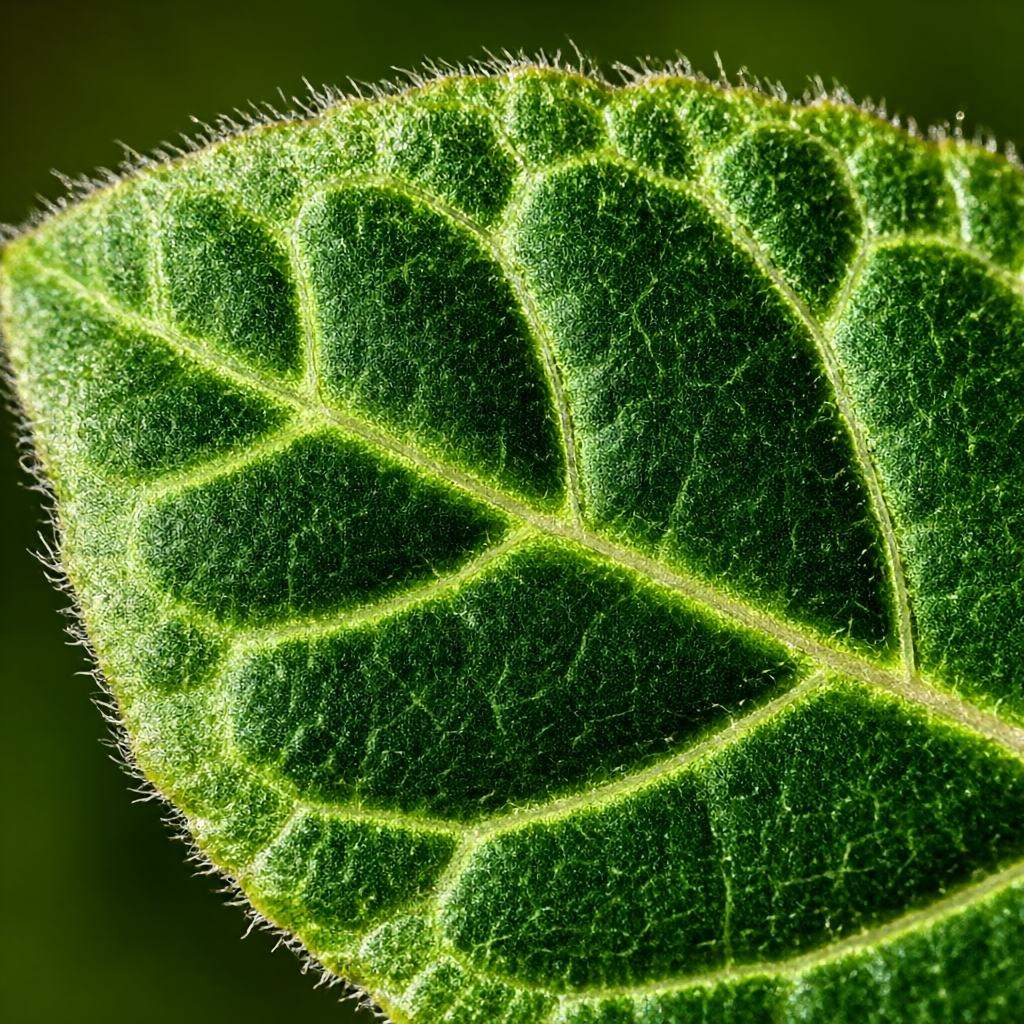
Two products leave the discs, one carrying power and one carrying electrons, and both feed the next stage. Neither one is sugar. Hold a sunlit leaf to the sky and the veins show as a pale net over green tissue.
1
2
3
The slowest enzyme
RuBisCO and the Calvin cycle
Sugar is built in the stroma, and that loop needs no light. But it needs ATP and NADPH, so the loop stalls in the dark. The key enzyme is RuBisCO, the most abundant protein on Earth. It is also slow, fixing about three CO2 each second.
Few enzymes work slower. A leaf fills itself with the stuff, often half its protein. RuBisCO pins CO2 to a five carbon sugar, and that product splits at once into two three carbon acids. Most of that carbon goes back to rebuild the start sugar, rather than leaving as fuel.
The loop turns three times for one sugar unit, six times for glucose. Plants build starch, fiber and wood from that output.
A waste gas that remade the sky
Oxygen and the air we breathe
Oxygen is waste here, and for two billion years the air held almost none. Then cyanobacteria in shallow seas released it, 2.4 billion years ago. That shift is the Great Oxygenation Event, and it poisoned much of the world. Life that could use oxygen gained a huge edge, since aerobic respiration yields 18 times more power.
Respiration runs the same chemistry backwards, taking sugar apart rather than building it. Plants do both, burning sugar at night and building it by day. The two loops never stop. Chloroplasts were once free living bacteria, swallowed by a larger cell over a billion years ago.
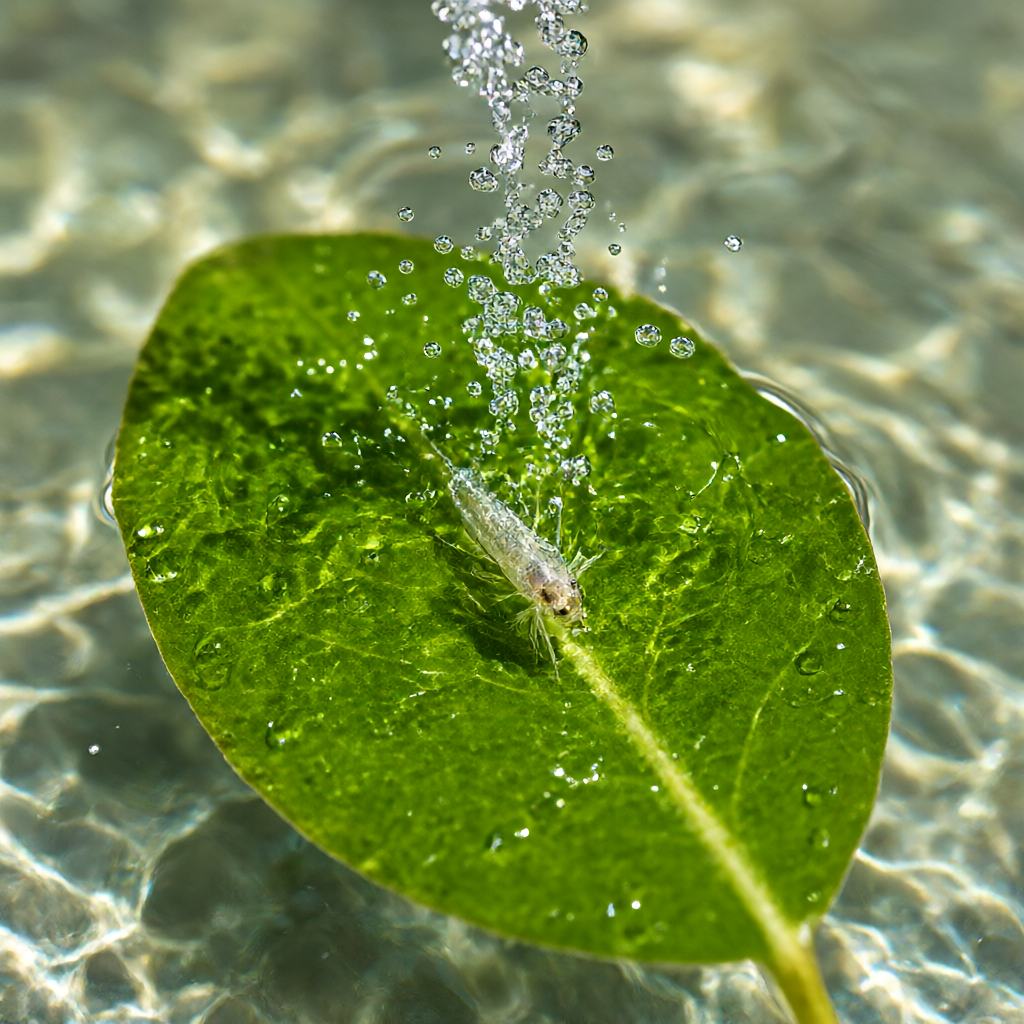
Some animals repeat the trick, and the Green Sea Slug keeps stolen chloroplasts working inside its own body. Modern air holds 21 percent oxygen, and in fact half the new supply comes from plankton. Drop a leafy stem into sunlit water and the proof rises in a stream of bubbles.
Heat, drought and a costly error
C4, CAM and the heat
Oxygen troubles RuBisCO, because the enzyme cannot tell the gases apart. On a hot dry day the pores shut to save water, and oxygen builds up inside the leaf. RuBisCO then grabs O2 instead of CO2, a waste called photorespiration. However, that error can eat much of the day’s gains.
Still, two workarounds evolved, one by space and one by time. C4 plants pump CO2 into special cells around the veins, and maize and sugarcane run on that trick in the heat. CAM plants work at night instead, opening pores after dark. They store the CO2 as an acid until morning, then run the loop with the pores shut.
Cacti and pineapple live this way, and they lose far less water. Speed is the price. A cactus grows slowly, but maize races ahead.
Yield, carbon and fake leaves
Why it matters now
Crops are sunlight turned into grain, so a harvest measures its power. Rice, wheat and soybean run the older C3 route, which wastes carbon. Engineers want the C4 pump in rice, although the trials are slow. Other teams tinker with RuBisCO, hunting a faster version.
A crop captures only 1 to 3 percent of the light falling on it. That gap is the target, and better canopy shape can lift it. Sunflowers track the sun, and that habit can raise capture by up to 30 percent. Forests and oceans lock up carbon on a huge scale, which makes this chemistry a climate tool.
Chemists build artificial leaves that split water with light. None of these systems yet beats a plain leaf on cost.
Side by side
How It Compares
| Trait | Photosynthesis | Euglena |
|---|---|---|
| Who runs it | plants, algae, bacteria | one celled swimmer |
| Site | thylakoid and stroma | chloroplasts in the cell |
| Energy | sunlight only | sunlight, or fed sugar |
| Carbon | CO2 from the air | CO2 dissolved in water |
| Movement | none, a leaf is rooted | swims toward light |
| Status | base of every food chain | common in ponds |
Common misreadings
What People Get Wrong
- Many people assume that the oxygen we breathe is released from carbon dioxide. Yet every molecule of it is torn from water deep inside the leaf.
- Popular diagrams often number photosystem I as the first step in the chain. But photosystem II fires first, and the numbers only follow the order of discovery.
- Some accounts claim CAM plants grow faster because they save so much water. Yet they stay slow, while maize races ahead in the heat of summer.
Going further
Sources and Further Reading
Five things to remember
Quick hits
- Chlorophyll rejects green light.
- Photosystem II runs before photosystem I.
- Oxygen comes from water.
- RuBisCO fixes three CO2 a second.
- Plankton makes half the oxygen.
During the growing season, the green pigment chlorophyll — which captures light energy for photosynthesis — dominates the leaf’s pigment composition, masking the yellow and orange pigments
[…] all green plants, the oak is fundamentally dependent on the process described in our article on Photosynthesis (the plant energy process), by which it captures sunlight in its leaves to build the sugars that fuel its enormous growth and […]
[…] It is a close relative of the willows and of the black poplar. As a green plant it depends on Photosynthesis, using its rounded leaves to make the sugars that build its fast-growing wood and root […]
[…] plane” because its bark and leaves recall the London plane. Like all green plants it lives by Photosynthesis, using its broad leaves to capture sunlight and build the sugars that fuel its fast […]
[…] plants, the Silver Birch is fundamentally dependent on the process described in our article on Photosynthesis (the plant energy process), by which its leaves capture sunlight to build the sugars that drive its rapid growth and feed the […]
[…] medieval name amara dulcis that referred to the taste of the stem. As a green plant it depends on Photosynthesis, but a large part of what it does with the resulting sugars is to manufacture the steroid alkaloids […]
[…] belong to the daisy family and are not closely related at all. As a green plant it depends on Photosynthesis, and like the rest of its family it converts the sugars it makes into a battery of sharp-tasting […]
[…] lack thorns and have noticeably downy undersides to the leaves. As a green plant it depends on Photosynthesis, and like other fruit trees it times its whole annual cycle around producing and then provisioning […]
[…] cause blistering and why it is left alone by most grazing animals. As a green plant it depends on Photosynthesis, and its entire architecture is a device for getting its leaves up into the light as fast and as […]
[…] synthesised from the plant’s compounds was named from Spiraea. As a green plant it depends on Photosynthesis, and the tall leafy stems that make it so conspicuous are built to carry the flower heads up above […]
[…] specific epithet angustifolium means “narrow-leaved”. As a green plant it depends on Photosynthesis, and it is a fast-growing, sun-loving species that puts most of its resources into rapid vertical […]
[…] near habitation rather than to any preference for urban ground. As a green plant it depends on Photosynthesis, and like most woodland-edge perennials it does the greater part of its growing early in the year, […]
[…] dots in the leaves, which look like pinholes when held to the light. As a green plant it depends on Photosynthesis, but a large part of what it manufactures goes into the naphthodianthrones and phloroglucinol […]
[…] aimed at disease resistance and concentrated flavour. Like all green plants it depends utterly on photosynthesis to fix the carbon that builds its leaves, runners and fruit. Botanically, what we call the […]
[…] the three are easily confused until they flower. As a green plant it is fundamentally dependent on photosynthesis, capturing sunlight in its leaves to build the sugars that fuel its growth, flowering and seed set. […]