 By st20113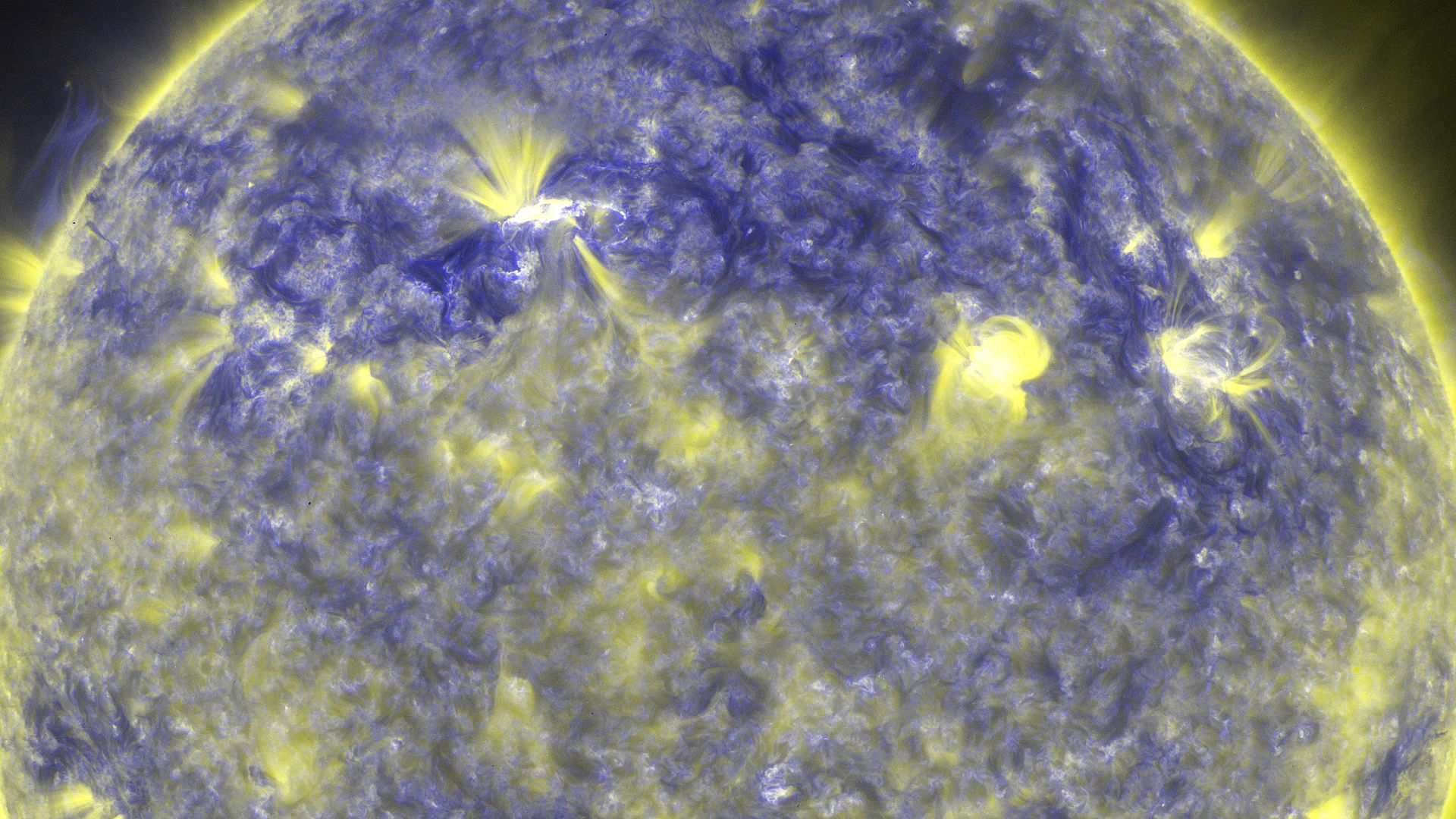
The Sun is the star at the center of the Solar System, an ordinary-looking yellow dwarf star of the spectral type G2V that nevertheless dominates everything around it. It contains about 99.8 percent of all the mass in the Solar System and holds the planets, including the Earth, in orbit by its immense gravity. With a diameter of roughly 1.39 million kilometers, the Sun could fit more than a hundred Earths across its face. Though modest by stellar standards, it is the source of nearly all the light and heat that makes life on our planet possible.
The Sun shines because of nuclear fusion in its core, where temperatures reach about 15 million degrees Celsius and pressures are crushing. Under these conditions hydrogen nuclei slam together and fuse into helium, releasing energy in the form of gamma-ray photons and tiny particles called neutrinos. This process converts about 600 million tons of hydrogen into helium every second, yet the Sun is so vast that it has enough fuel to shine steadily for roughly ten billion years. The energy born in the core is what eventually warms the planets and powers the weather, the oceans, and life itself.
The journey of a single photon from the core to the surface is astonishingly slow. In the dense inner region, a photon born in the core enters the radiative zone, where it is endlessly absorbed and re-emitted by surrounding matter, wandering in a random zigzag that can take around 100,000 years to travel the roughly 500,000 kilometers to the next layer. Above this lies the convective zone, where hot gas rises in rolling columns, like boiling water, carrying energy the rest of the way to the visible surface, the photosphere. From there light escapes into space and reaches Earth in just over eight minutes.
Above the photosphere lie the cooler, darker sunspots, which appear where the Sun’s magnetic field suppresses rising heat; their number rises and falls on a regular cycle of about eleven years, a rhythm that also drives changes in solar activity. At times the tangled magnetic fields snap and release enormous bursts of radiation and charged particles called coronal mass ejections, which can stream outward and, when they strike Earth, produce auroras and occasionally disrupt satellites and power grids. The Sun’s outer atmosphere, the corona, is a faint, superheated halo visible during a total eclipse.
The Sun is the engine of life on Earth. Its light drives photosynthesis, the process by which plants and algae turn carbon dioxide and water into food and oxygen, forming the base of nearly every food chain. Its warmth evaporates ocean water and powers the water cycle, filling rivers and raining on forests, while its steady output keeps the planet within the narrow range where liquid water can exist. Without the Sun there would be no climates, no seasons in their familiar form, and no living ecosystem. For this reason the Sun has been revered in nearly every human culture as a giver of life, and in science it remains the standard against which all other stars are measured. Studying the Sun also helps us understand the distant stars and the habitability of planets around them, making our own star a gateway to the wider universe.